
When the skull of the Solør Viking Woman was first excavated in 1900, it went into storage as another ancient burial; a century later, forensic scans revealed something the original excavators could not have seen.
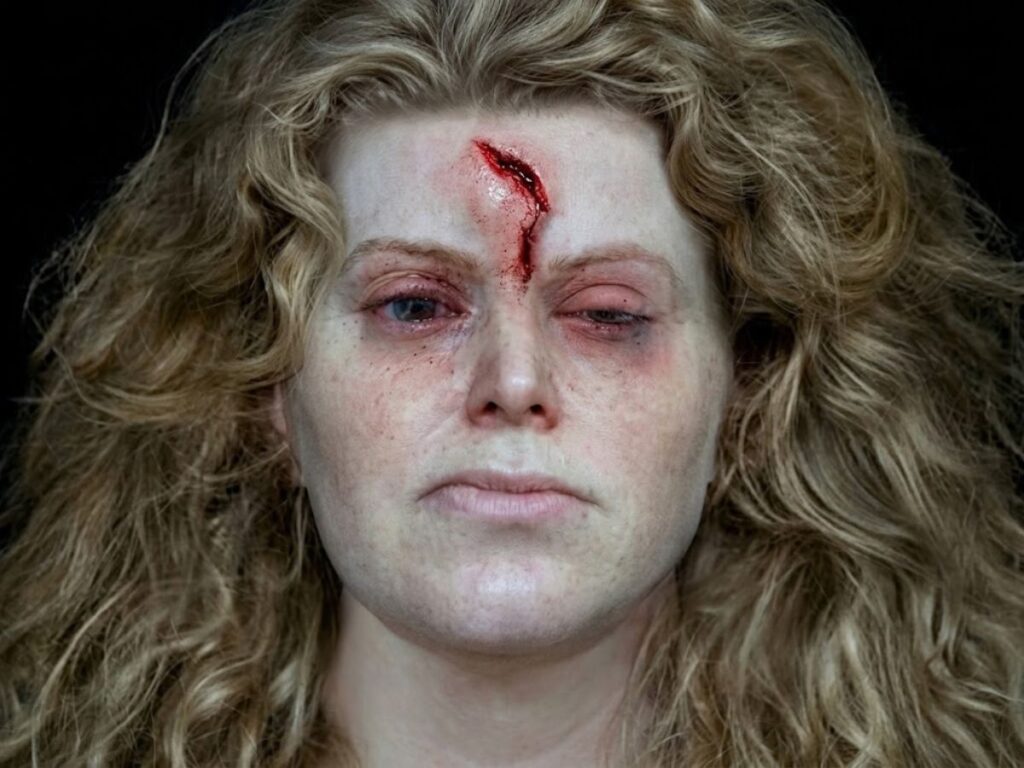
It found evidence that the slash across her forehead had begun to heal, meaning this teenager survived the blow and lived beyond the fight.
What it cannot tell us is about the life she led afterward, and why a single piece of forensic evidence can rewrite what we thought we knew about women in early medieval violence.

A Burial in Solør, 1900
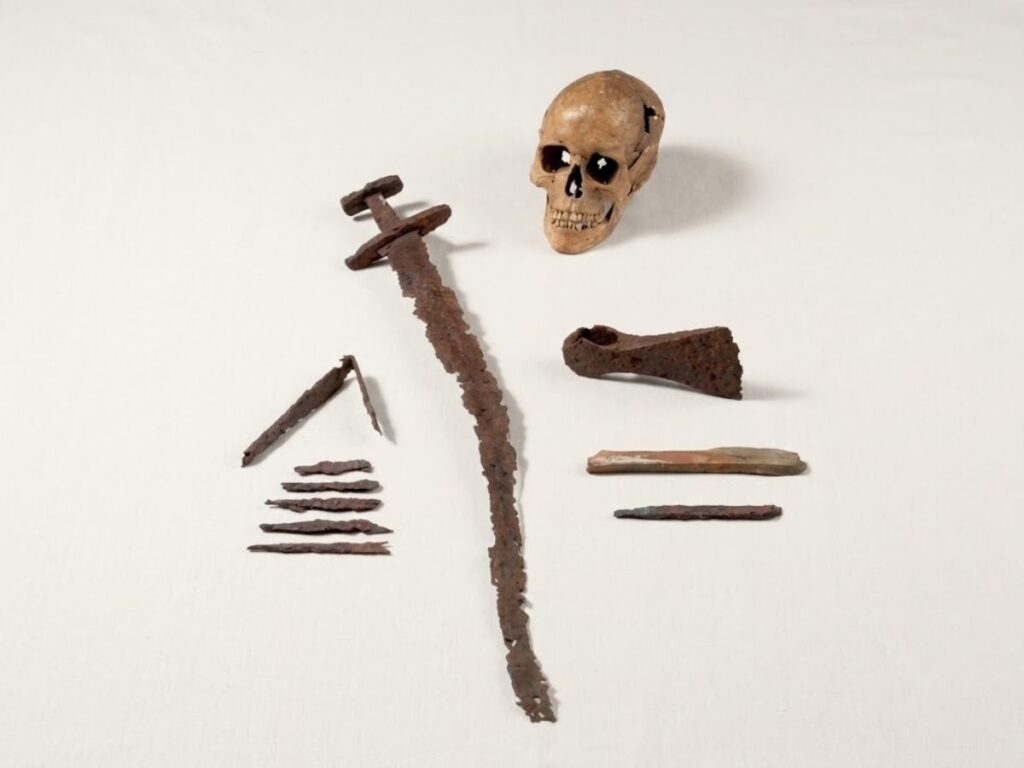
Solør is a stretch of forested country in eastern Norway, in what’s now Innlandet county, east of the Glomma river. In 1900, a Viking-age grave was opened there, and the contents, including a reasonably well-preserved skull and a set of grave goods consistent with a warrior burial, were sent to Oslo, where they were absorbed into the collections of what became the Museum of Cultural History at the University of Oslo.
The excavation record, by the standards of the day, was pretty good: a body, weapons, a location, and a tentative identification of the occupant as male.
The grave goods pointed to a male, with swords and axes generally being associated with men, especially in those days. The pelvis in this burial wasn’t well preserved, so researchers concluded the grave belonged to a male.
Burials like this one fed into the picture most people carried of the Viking world: raiders and traders with the occasional famous queen, and the women mostly at the loom. A woman buried with a sword, if she turned up at all, was treated as an anomaly or a mislabel.
The Solør skull sat in its box in Oslo through two world wars, the museum’s rebuilding, and slowly waited for technology to get clever enough to tell a different story.
Hooked on this mystery? Get more stories like it in your inbox.
The Scan That Changed the Reading
The question came in the early 2000s, as a wave of reassessment ran through Scandinavian collections. New techniques for determining biological sex from the skull itself, combined where possible with ancient DNA, began to turn up women in burials that had been cataloged as male since the Victorian era.
Osteologists went back through the stores, remeasured, re-sexed, and in a number of cases, including Solør, concluded that the person in the grave had been a woman, estimated to be in her late teens at the time of death.
When the skull was examined with modern forensic imaging, including CT scanning that could show the bone’s internal structure, a long slash across the forehead that had been visible to the naked eye revealed a detail the 1900 excavators couldn’t have seen.
The edges of the wound weren’t clean and sharp, as they would be in a cut inflicted at or very near the moment of death. They were rounded, remodeled, and showed the characteristic signs of bone that had begun to grow back.
In the original 1900 examination, it would have been noted as damage, if it was noted at all; distinguishing a wound inflicted in life from damage done after death, or in the ground, isn’t something you can do reliably with the naked eye on a bone that has been buried for a thousand years.
What Healing Bone Actually Shows
Bone is a living tissue, and when it’s cut or broken, it responds. The response is slow by soft-tissue standards, but it’s visible. Within the first week or two after a serious skull injury, the body begins laying down new bone around the wound margins, a process called remodeling.
The sharp edge of a fresh cut, the kind a sword or axe would leave on living bone, is gradually smoothed over as the body attempts to close the gap. The remodeled margin looks distinct under magnification and in cross-section, quite different from an unhealed cut.
A cut inflicted at or very near the moment of death, which forensic anthropologists call a perimortem injury, looks essentially the same as one made days after death, because the body didn’t survive long enough to begin repairing it.
The edges are clean, the inner surface of the cut matches the surrounding bone, and there’s no new growth. A wound showing active remodeling, by contrast, is unambiguous evidence that the person lived long enough for the biological machinery of healing to begin its work. Weeks at minimum. Possibly much longer.
The slash on the Solør woman’s forehead showed that remodeling. The scan gave the clear signature of a wound that had started to close. How long exactly, the bone can’t say, because remodeling continues for months and the stage reached at death would be hard to pin to a particular period of time.
What the Skull Can’t Tell Us
A healed cut on a skull is one piece of forensic data. It tells us that this young woman, late teens by the best estimate from the skeletal evidence, received a sharp-force injury to the forehead severe enough to leave a lasting mark on the bone itself, and survived long enough for that mark to begin healing.
It doesn’t tell us who struck her, or why, or where. It doesn’t tell us whether she fought back, whether the blow came in a raid, a feud, a domestic quarrel, or a judicial duel, or whether she was a bystander caught in something that had nothing to do with her.
Grave goods, including weapons, provide a separate line of evidence. A woman buried with a sword and an axe in 10th-century Norway could have wielded them in combat, inherited them, been given them as symbols of status and lineage, or had mourners place them there to make a statement about her family rather than her life.
Grave goods reflect choices made by the living, and the living had their own reasons. Neither on its own proves she was a fighter.
What the skull does establish is that violence happened to her and she survived it. Possibly the weapons may yet have other explanations.
Birka, Solør, and the Reassessment of Viking Women
The most publicized case in the same wave of reassessment was the warrior burial at Birka, in Sweden, labeled Bj.581, excavated in the 1880s and treated for over a century as the textbook example of a high-status male Viking fighter.
Buried with a sword, an axe, a spear, arrows, two horses, and a set of gaming pieces interpreted as a tactician’s kit, Bj.581 was the standard picture of the Viking warrior for generations.
In 2017, a team led by Charlotte Hedenstierna-Jonson published osteological and ancient-DNA evidence that the individual in Bj.581 was biologically female.
The reaction was divided. Some scholars accepted the finding and argued it required a rethink of how Viking-age weapon burials had been read. Others argued the bones in the box had been mixed up at some point in the museum’s history, that a woman buried with weapons didn’t necessarily use them, or that the gaming pieces could be read differently.
A follow-up paper in 2019 addressed many of the objections and reaffirmed the identification.
Birka made the case through sex determination and funerary context. Solør added a healed battle wound on a woman’s skull, and those are different kinds of evidence, with the second harder to argue with than the first because it’s a change in the bone itself rather than a reading of the objects around it.
Taken together with other reassessed burials across Scandinavia and the British Isles, including the Repton mass burial in Derbyshire and several Norwegian graves currently under review, the picture that emerges is that women were present in the violence of the period, as victims, as survivors, and in at least some cases as participants.
What Is Still Open, and What Would Settle It
The Solør woman’s remains are still in Oslo, and the analysis of them is ongoing. Ancient DNA work, which has advanced considerably since the initial reassessment, can in principle confirm biological sex independent of skeletal measurements, and establish genetic relationships with other individuals in nearby burials.
Isotope work can establish whether she grew up locally in eastern Norway or arrived from elsewhere, perhaps as part of a raiding party or maybe even a long-distance conflict. Radiocarbon dating can tighten the century of her burial. None of these will tell us who swung the weapon that opened her forehead, but each narrows the field in which that question sits.
What would settle the larger argument about women and Viking-age violence is the slow accumulation of reassessed graves, each with its own combination of osteological, genetic, chemical and contextual evidence.
The direction is clearer than the destination, and the next 20 years of museum-store work in Scandinavia and the British Isles will probably matter more than any single spectacular find.
For now, we know that the Solør skull was a teenage girl in Viking-age Norway who was struck across the forehead with a bladed weapon hard enough to cut into the bone, but she lived.
We don’t know for how long, or what she did with the time, or how she died in the end, but she definitely wasn’t male.
Love an unsolved mystery?
Get the strange, the unexplained and history's loose ends straight to your inbox.

Kylie Lang is a nationally syndicated travel journalist with bylines on the Associated Press Wire & more, a medieval history writer, and the founder and lead author of Tales of the Middle Ages (talesofthemiddleages.com) and Unsolved World History (unsolvedworldhistory.com). She holds a BA (Honours) in History from the University of Kent and is a member of the British Guild of Travel Writers.