You’ve seen the photograph a hundred times: the gold mask, the black eyes, the striped headdress. What you probably haven’t been told is that the tomb on the other side of that doorway is, by pharaonic standards, oddly small.
Four cramped rooms in a corner of the Valley of the Kings, hurriedly decorated and painted in a style that doesn’t quite match the boy inside.
For more than a century, Egyptologists have argued that this doesn’t add up. The theory is that KV62 wasn’t built for Tutankhamun at all, and that a second, undisturbed burial lies behind its painted north wall. It’s known as Nefertiti.
So why, in 2026, is the question still open, and why hasn’t anyone just looked?
The Tomb That Was Too Small for a King
I’ve recently read a book called Daughter of Egypt by Marie Benedict, which reignited my interest in the Pyramids. It follows Lady Evelyn Herbert, the daughter of Lord Carnarvon, as she joins Howard Carter in 1920s Egypt on a personal quest to find the lost tomb of Hatshepsut, the female pharaoh.
Although Lady Evelyn didn’t find Hatshepsut, she helped discover Tutankhamun’s tomb in the Valley of the Kings. Howard Carter found the entrance on November 4, 1922, in a patch of the Valley of the Kings everyone else had written off. Lady Evelyn is often named as one of the first people to enter the tomb after more than 3,000 years.
It’s an interesting book, although a little slow-paced, and well-researched, which is one of the things that sparked this article.
When they discovered the tomb, they found more than 5,000 objects: nested gold coffins, a solid gold mask, chariots, shrines, and folding beds. Carter and his team took ten years to clear the place.
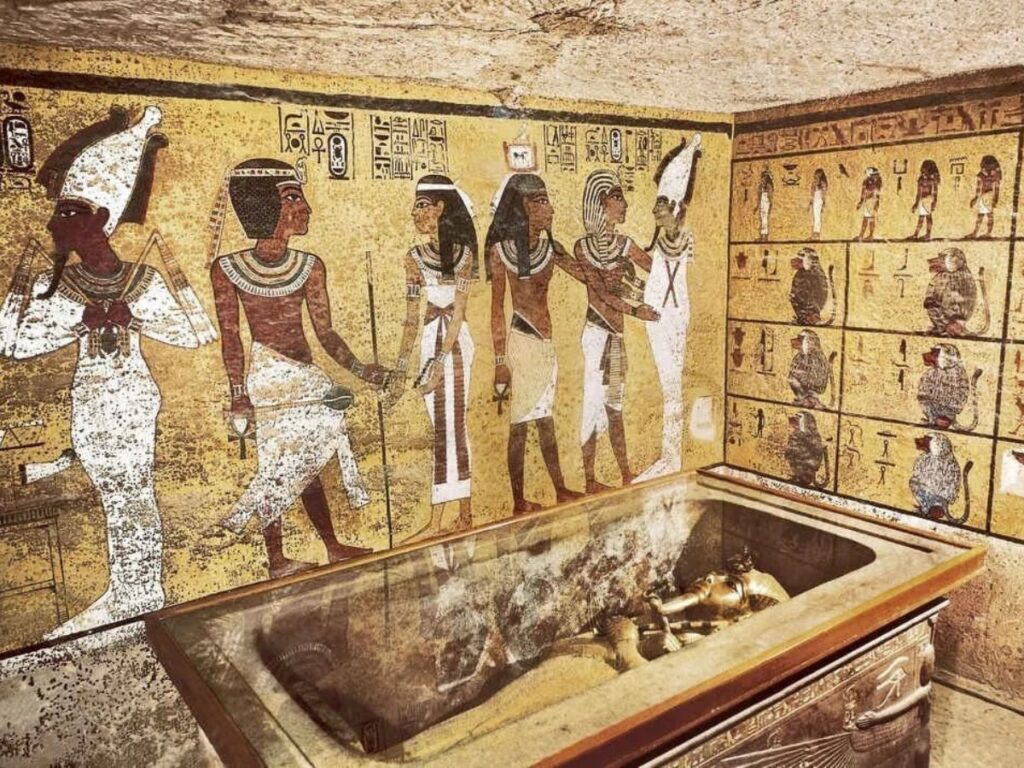
What didn’t come out of it, at least in the shape you’d expect, is a royal tomb. KV62, as it’s known, has four small chambers off a short entrance corridor.
The tombs of Tutankhamun’s near-contemporaries, Amenhotep III and Horemheb, are vast multi-level complexes with long descending passages, pillared halls, and painted programs that run for hundreds of feet.
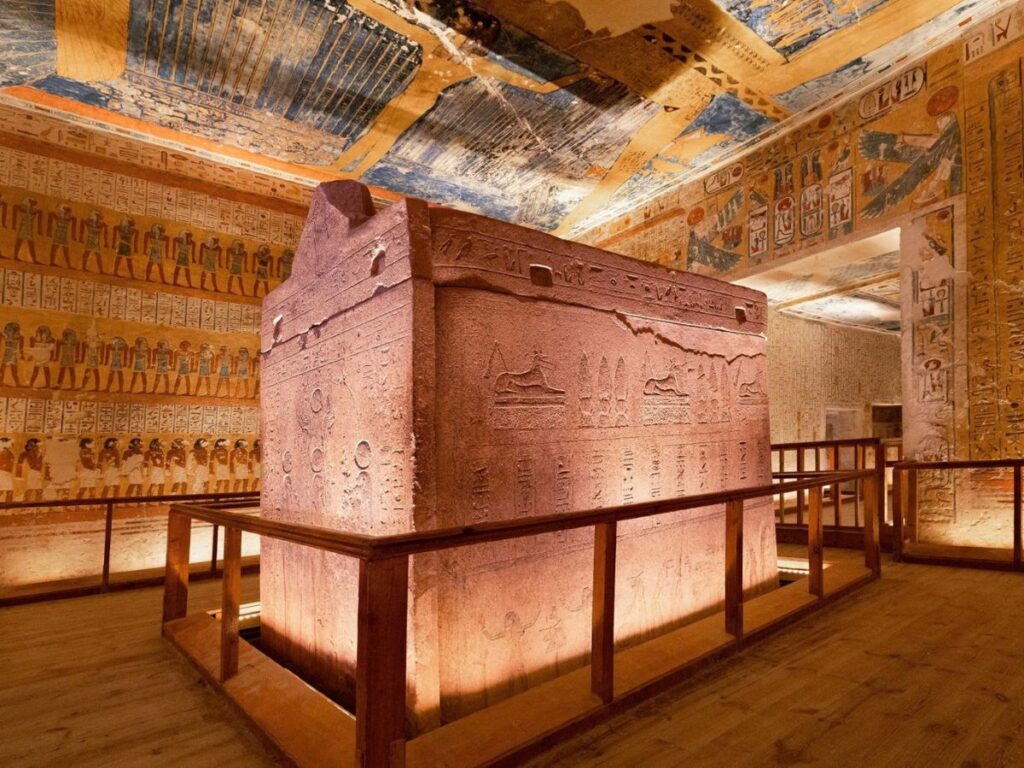
Even Ay, the elderly courtier who succeeded Tutankhamun and reigned for only four years, ended up in a larger, better-decorated tomb, KV23.
Historians have explained it away because Tutankhamun died suddenly, at around 19, and that his officials had to bury him in whatever hole was available.
This meant the tomb was probably intended for a private official, hastily upgraded when the king died before his own tomb was ready. It’s a reasonable explanation, and for most of the 20th century it was the one Egyptologists mainly agreed on.
But the small size, the awkward layout, and one particular oddity, the fact that the burial chamber turns 90 degrees to the right off the antechamber rather than continuing straight ahead, have meant it’s been a constant source of discussion.
That right-angle turn is what queens’ tombs did in the Amarna period. Kings’ tombs turned left.
Hooked on this mystery? Get more stories like it in your inbox.
Where Nefertiti Went

Nefertiti was the great royal wife of Akhenaten, the heretic pharaoh who abandoned Egypt’s gods for the sole worship of the Aten, the sun-disk, and moved his capital to a new city at Amarna.
She appears everywhere in the art of that court, often shown at the same scale as her husband, sometimes striking down enemies in poses reserved for kings. Then, in about year 12 of Akhenaten’s 17-year reign, she disappears from the record.
She may have died or fallen from favor. No confirmed tomb or mummy has been found, and no burial goods either.
Two badly damaged female mummies from tomb KV35, known as the Elder Lady and the Younger Lady, have both been proposed as her at different times, and neither identification has held up conclusively.
One strand of scholarship holds that Nefertiti kept going after Akhenaten’s death, ruling Egypt in her own right under the throne name Neferneferuaten, and possibly again as the shadowy pharaoh Smenkhkare, bkhamucourt’s arte to the throne as a child.
If that’s right, she was a reigning pharaoh, and a reigning pharaoh needed a royal tomb. Nobody has ever found one.
Nicholas Reeves and the Ghost Doorways

Nicholas Reeves, a British Egyptologist, has spent years working on KV62 and knows the tomb better than anyone alive. In 2015, he published a paper called “The Burial of Nefertiti?” that reignited the debate.
Reeves had been studying high-resolution laser scans of KV62’s walls, produced by the Madrid-based conservation company Factum Arte for a facsimile of the tomb.
Under the painted plaster of the north and west walls of the burial chamber, he said, the scans showed faint straight lines: the outlines of two blocked doorways.
He argued the western outline was a storeroom, and the northern outline was something else, a continuation of the tomb into a further chamber that had never been entered.
Looking again at the paintings on the north wall, he argued that the figure conventionally identified as Ay performing the “opening of the mouth” ritual over Tutankhamun was actually the reverse: Tutankhamun performing the ritual over Nefertiti, with the mummy’s face recut and the cartouches overwritten.
On this reading, KV62 was the outer part of Nefertiti’s tomb, reused for the boy king when he died unexpectedly, with her burial chamber sealed behind af there’s a chamber back there, ground-penetrating radar should see it.
The Radar Wars: 2015, 2016, 2018
In November 2015, the Egyptian Ministry of Antiquities invited Japanese radar specialist Hirokatsu Watanabe to scan the north and west walls of the burial chamber.
In March 2016, then-antiquities minister Mamdouh Eldamaty announced at a press conference in Cairo that Watanabe’s data showed, with 90% confidence, two voids behind the walls, containing organic and metallic material.
Watanabe never released the raw data in full, and other radar specialists were skeptical from the start.
The National Geographic Society commissioned a second survey, this time using a different radar system and a different operator, Dean Goodman of GPR-Slice.
Goodman scanned the same walls in early 2016 and reported that he couldn’t see the voids Watanabe had reported, calling the data ambiguous.
A third survey was carried out in February 2018 by a team from the Polytechnic University of Turin, led by Franco Porcelli, using three different types of radar plus electrical resistivity tomography.
Their conclusion, announced at a conference in Cairo that May, was blunt: no evidence of hidden chambers, no evidence of a doorway, and no evidence of a corridor. If anything was back there, their instruments couldn’t detect it, and they were sensitive enough to detect it.
That should have settled it, but it didn’t. Ground-penetrating radar in a place like KV62 is unusually difficult: the limestone is fractured and heterogeneous, the air gaps in the rock produce false positives, and the antenna has to be dragged along a painted wall you’re not allowed to touch.
Watanabe, Goodman, and the Turin team weren’t looking at the same walls with the same instruments in the same conditions, and they read the results through different assumptions. Reeves has continued to argue that the null results don’t disprove the theory, only that the survey conditions weren’t good enough to detect what’s there.
His critics have argued back that at some point, the absence of evidence starts to look like evidence of absence.
Why Nobody Has Just Drilled Through
The obvious question to ask is why the Egyptian authorities don’t simply put a small hole through the wall and look. The answer is the north wall itself.
It’s one of the most famous painted walls in the ancient world. Three scenes in yellow and red on a white ground: Ay in leopard skin performing the opening of the mouth on the mummified Tutankhamun; the young king being embraced by the goddess Nut; Tutankhamun and his ka being greeted by Osiris.
The paint is original, applied around 1323 BCE, and has already suffered from a century of humidity and visitors. Drilling into it would risk destroying a piece of art people travel across continents to see, based on a radar reading that three teams can’t agree on.
Luckily, less invasive options exist. Muon tomography, the technique that found a large void in the Great Pyramid in 2017, works through stone without touching it in principle, though its resolution at the depths involved in KV62 is marginal.
Micro-drilling at the edges of the wall, in areas of modern plaster rather than ancient paint, has been proposed and rejected more than once.
There’s also a political dimension. The Egyptian Ministry of Tourism and Antiquities has already been burned once by announcing a discovery without evidence to back it up, and Zahi Hawass, the former antiquities minister, has publicly scorned the hidden-chamber theory for years.
He has said flatly that there’s no chamber, that Nefertiti isn’t in KV62, and that Reeves is wrong. Any new work at KV62 has to have concrete proof.
What Would Actually Settle It
What would settle it is a radar or muon survey clean enough that three independent teams look at the data and agree on what they’re seeing: either a void of a shape and size consistent with a chamber, or solid limestone. So far, no survey has been that clean, and the walls of KV62 make it very hard for one ever to be.
If a void were confirmed, the next step would probably be a small fiber-optic camera fed through a pre-existing crack, or through a discreet hole in a section of modern restoration plaster. That’s how the sealed chambers inside the Great Pyramid were first glimpsed.
Actually opening a doorway, if one were found, would take years, not months, with the painted wall painstakingly removed and reinstalled in a way Carter would have found unimaginable.
The other question, of course, is whether Nefertiti’s burial has to be in KV62 to exist. She may lie in a tomb no one has found yet, in the Valley of the Kings or in the cliffs above Amarna, or she may be the Younger Lady from KV35 after all, still cataloged in Cairo since 1898.
Reeves’s theory is only one possible answer to where she is.
Of all the mysteries left in Egyptology, the burial of Nefertiti is the most famous unsolved case. It’s also the only one where the answer is, in principle, waiting a few feet behind a painting that Howard Carter first held a candle up to on a November evening in 1922.
Love an unsolved mystery?
Get the strange, the unexplained and history's loose ends straight to your inbox.

Kylie Lang is a nationally syndicated travel journalist with bylines on the Associated Press Wire & more, a medieval history writer, and the founder and lead author of Tales of the Middle Ages (talesofthemiddleages.com) and Unsolved World History (unsolvedworldhistory.com). She holds a BA (Honours) in History from the University of Kent and is a member of the British Guild of Travel Writers.