
Amelia Earhart and her navigator, Fred Noonan, took off from Lae, New Guinea, on July 2, 1937, aiming for a speck of coral called Howland Island in the middle of the Pacific, but never arrived. The US Navy searched an area the size of Texas and found nothing.
So why, 89 years later, is a team from Purdue University and the Archaeological Legacy Institute boarding a ship and sailing to a different island entirely? Because even after all this time, evidence keeps pointing at Nikumaroro, a spit of coral roughly 350 miles southeast of Howland, and because something is sitting in its lagoon that shouldn’t be there.
The question is whether that evidence is as strong as its supporters say, or whether we’ve been spun a yarn to keep us guessing.

What Actually Happened on Amelia Earhart’s Last Flight on July 2nd?
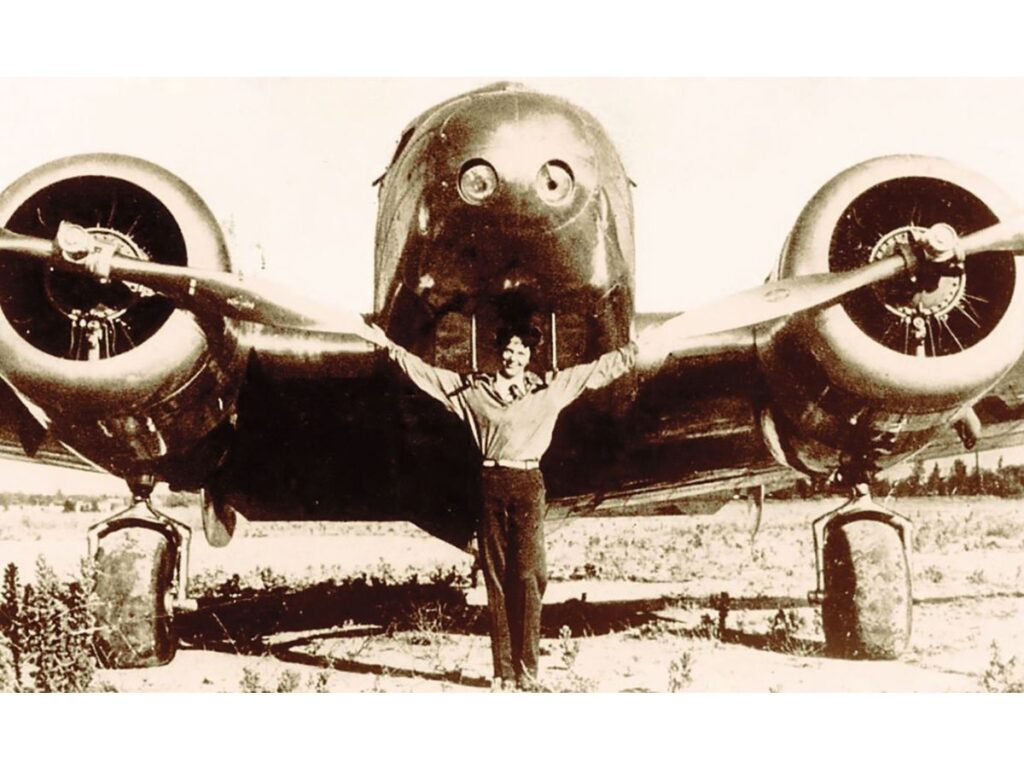
Earhart and Noonan left Lae at 10 a.m. local time in a twin-engine Lockheed Electra 10-E, the aircraft Purdue Research Foundation had helped her buy and which she called her Flying Laboratory.
They were on the second-to-last leg of a round-the-world flight, heading for Howland Island, a strip of land less than two miles long where the US Coast Guard cutter Itasca was waiting with fuel and a radio, but, as we know, they didn’t arrive.
The last confirmed transmission from the Electra reached the Itasca at 8:43 a.m. Howland time on July 2. By then, Earhart’s voice sounded tense, and she reported that she was running on a line of position of 157 by 337 degrees, a navigational bearing that ran roughly northwest to southeast through Howland. Then the radio went quiet.
The Navy assumed the Electra had ditched at sea somewhere near Howland and sent a search that covered around 250,000 square miles of ocean. It found no wreckage, no oil slick, no life raft, nothing.
The official conclusion was that the plane went down within sight of its destination and sank. And it’s still the answer many aviation historians consider most likely.
However, the Nikumaroro Hypothesis sees it differently. Extended southeast, it runs almost directly through a chain of uninhabited coral atolls then called the Phoenix Islands. One of them was Gardner Island, known today by its Kiribati name of Nikumaroro. If Earhart couldn’t find Howland and instead followed the line, she would have flown straight toward it.
The Radio Messages After She Vanished
For three days after Earhart vanished, radio operators across the Pacific and on the US mainland reported picking up faint signals they believed came from her. Some were dismissed at the time as hoaxes, and many certainly were. But a subset of them, cataloged in detail by researcher Ric Gillespie of the International Group for Historic Aircraft Recovery, or TIGHAR, came in on frequencies the Electra could have used.
And at times consistent with when its engines could have run to power the radio, and from bearings that repeatedly converged on the Phoenix Islands.
The US Navy did take some of these seriously enough to divert its search. On July 9, 1937, Navy floatplanes from the battleship USS Colorado flew over Gardner Island. The pilots reported seeing signs of recent habitation, but no sign of an aircraft and no people.
They noted the island had been uninhabited for decades, remarked on the signs, and moved on.
Skeptics point out, fairly, that the post-loss radio signals include a great deal of noise, and that the strongest signals came from operators who very badly wanted to hear Amelia Earhart. Supporters counter that a hoaxer in Florida couldn’t have plausibly transmitted on the Electra’s exact frequency for three days from a moving location, and that the pattern of bearings is hard to explain by coincidence.
Hooked on this mystery? Get more stories like it in your inbox.
The Bones on the Beach
In September 1940, a work party from the newly established British colonial settlement on Gardner Island found a partial human skeleton under a ren tree on the island’s southeast end. Nearby were a woman’s shoe, a sextant box, and the remains of a small campfire with fish, turtle, and bird bones around it.
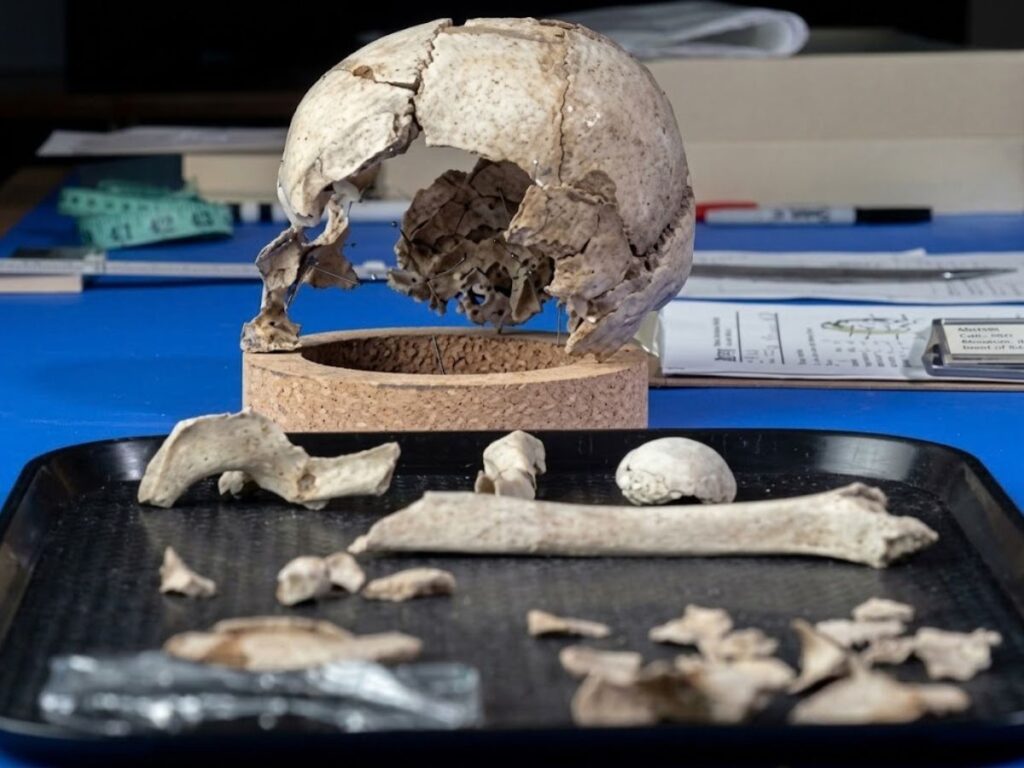
The British colonial officer Gerald Gallagher, who ran the settlement, packaged up the 13 bones that could be found and sent them to Fiji for examination.
In 1941, a physician named Dr. D.W. Hoodless at the Central Medical School in Suva measured the bones and concluded they belonged to a stocky European or mixed-race male, roughly 5’5″ tall. The bones themselves were subsequently lost.
What has changed is that Hoodless’s original measurements survived in the file. In 2018, forensic anthropologist Richard Jantz of the University of Tennessee ran those measurements through a modern skeletal analysis program called Fordisc, which he’d helped develop, and compared them against Earhart’s known height, build, and limb proportions from tailored clothing and photographs.
His conclusion, published in the journal Forensic Anthropology, was that the bones were more similar to Earhart than to 99% of individuals in a large reference sample.
That doesn’t mean the bones were Earhart’s. Jantz’s analysis is a statistical statement about consistency, and it depends on Hoodless’s 1941 measurements being accurate. Hoodless was working with primitive tools and a very small number of bones, which is why his own diagnosis of sex is now doubted.
A Shoe, a Compact, and a Jar of Freckle Cream
The artifacts recovered from Nikumaroro over decades of TIGHAR expeditions are, in some ways, more interesting. On the southeast end of the island, near where Gallagher’s men found the skeleton, later teams turned up the sole and heel of a woman’s blucher-style oxford shoe, manufactured in the 1930s and consistent in size with what Earhart is known to have worn.
They also found a small compact-style cosmetics case, and the broken pieces of a jar that once contained Dr. Berry’s Freckle Ointment, a skin-lightening cream sold in the United States in the 1930s and marketed to women who wanted to fade their freckles.

Amelia Earhart had freckles and, by her own account in interviews, disliked them.
They also found a glass medicine vial and pieces of a broken mirror from a compact manufactured in the 1930s. None of these items alone proved anything, but the evidence was definitely mounting.
Castaways of various nationalities passed through the Phoenix Islands during the 19th and 20th centuries, and the British colony that Gallagher ran was on Nikumaroro from 1939 to 1963. Any of the objects could, in theory, belong to a colonist.
The TIGHAR argument is that the concentration of specifically American, specifically 1930s, and specifically female-associated objects at the site where the bones were found is unlikely to be a coincidence.
The counter-argument is that a determined searcher will find what they’re looking for, and that Nikumaroro is a small island with a documented human presence covering most of the 20th century.
What the artifacts do establish beyond reasonable doubt is that somebody was living, or trying to live, at the southeast end of the island at some point in the 1930s or 1940s. Who that person was, they can’t tell you.

The Bevington Object and the Taraia Object
Three months after Earhart disappeared, in October 1937, a British colonial officer named Eric Bevington visited Gardner Island as part of an assessment of the Phoenix group for possible settlement.
As part of his research, he naturally took photographs. One of them, taken from the shoreline looking out across the reef, shows something protruding from the water near the reef edge. For decades, nobody noticed.
Then in the late 1990s TIGHAR reexamined the photo and identified the shape as potentially consistent with a Lockheed Electra’s landing gear assembly, sticking up from the reef where the plane might have come to rest.
Forensic imaging analysts examined the Bevington Object in 2010 and reported that it was consistent with landing gear. Other analysts have disagreed, arguing the shape is more likely to be a piece of coral or debris.
The reef has, as you can imagine, changed dramatically since 1937, and any wreckage that was there is presumed to have been washed off into deep water long ago.
The Taraia Object is different. It’s a visual anomaly first spotted in satellite imagery of Nikumaroro’s lagoon in 2020, roughly the right size and shape for an Electra, and, according to the Archaeological Legacy Institute’s analysis of older aerial photographs, apparently in the same position in the lagoon since at least 1938.
That’s what the October 2026 expedition is going to look at. Sixteen people, including archaeologists, a maritime archaeologist, filmmakers, and three representatives from Purdue, will sail from Tarawa in the first week of October (next week), spend several days on the island, and try to determine whether the object under the lagoon is aircraft aluminum or just an oddly shaped piece of coral.
If it’s the Electra, the case is effectively closed, and if not, then sadly, nothing has changed.
Where This Leaves Us
The bones are lost, and the reanalysis rests on measurements taken by a man who reached the wrong conclusion. The artifacts are consistent with a 1930s American woman and equally consistent with any number of other explanations.
The radio signals include hoaxes mixed in with the ones that look real, and separating them is a judgment call. The Bevington Object is a smudge on a photograph. Even the 2017 experiment in which forensic dogs trained to detect human remains alerted at the site under the ren tree is suggestive rather than conclusive.
What has kept the hypothesis alive, decade after decade, is that no serious alternative has more evidence behind it. The crashed-and-sank theory is the null hypothesis and it’s perfectly plausible, but it’s also the answer that requires no explanation for the bones, the shoe, the freckle cream jar, the radio bearings, or the object in the lagoon.
The Japanese-capture theory, which surfaces in popular books periodically, has essentially no documentary support and requires the Electra to have flown in the opposite direction from its intended course for reasons nobody can explain.
If the Taraia Object turns out to be an Electra, the argument ends. The bones are gone, the reef has shifted, and the coconut crabs on Nikumaroro are large enough and numerous enough to have scattered anything organic decades ago.
What would settle the case, aside from the aircraft itself, is a DNA match from remains that no longer exist, or a serial-numbered component from the plane. The team that leaves Tarawa in October is going out to see whether the last piece of physical evidence is where the satellite says it is.
In a case that has been running for 89 years, that’s the closest thing to an answer anyone has been able to promise.
Love an unsolved mystery?
Get the strange, the unexplained and history's loose ends straight to your inbox.

Kylie Lang is a nationally syndicated travel journalist with bylines on the Associated Press Wire & more, a medieval history writer, and the founder and lead author of Tales of the Middle Ages (talesofthemiddleages.com) and Unsolved World History (unsolvedworldhistory.com). She holds a BA (Honours) in History from the University of Kent and is a member of the British Guild of Travel Writers.